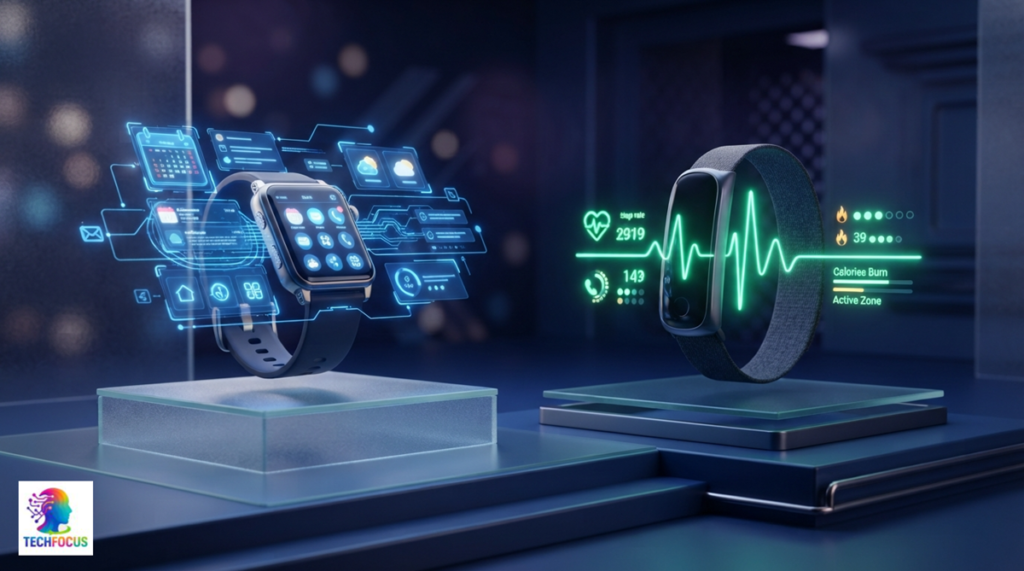
Smartwatch vs fitness band is a decision that comes down to being honest about what you’ll actually use daily, rather than being drawn in by whichever device has the longer feature list. This guide breaks down smartwatch vs fitness band practically, focusing on real daily use rather than marketing comparisons that make every feature sound essential.
Smartwatch vs Fitness Band: What’s the Core Difference?
A fitness band is generally a simpler, more focused device built primarily around activity and health tracking, with a longer battery life and a smaller form factor. A smartwatch expands significantly beyond tracking into notifications, apps, calls, and other smartphone-adjacent functionality, generally at the cost of a shorter battery life and a larger, more noticeable device on your wrist.
What Does a Fitness Band Do Well?
Fitness bands excel specifically at what they’re built for: step counting, heart rate tracking, sleep monitoring, and basic activity metrics, often with battery life measured in many days rather than a single day, since they’re not running a full range of smartphone-adjacent features that drain power quickly.
What Does a Smartwatch Do Well?
Smartwatches genuinely extend your smartphone onto your wrist, letting you view notifications, respond to messages, make payments, and run various apps without pulling out your phone. For people who want to reduce phone-checking throughout the day, this convenience can be genuinely valuable, not just a novelty.
Do You Need Smartphone Notifications on Your Wrist?
This is one of the most important questions in the smartwatch vs fitness band decision. If you find yourself constantly checking your phone for messages and notifications, a smartwatch can genuinely reduce that behaviour by letting you glance at your wrist instead. If you’re comfortable checking your phone periodically without constant micro-interruptions, this specific smartwatch advantage matters less to your daily life.
Do Design and Comfort Differ Between the Two?
Often yes. Fitness bands tend to be smaller and lighter, which some people find more comfortable for continuous wear, including overnight sleep tracking. Smartwatches are generally bulkier due to their larger display and additional components, which some users don’t mind at all, while others find them less comfortable for round-the-clock wear. This is a genuinely personal preference worth testing in person when possible before committing to either side of the smartwatch vs fitness band decision.
How Much Does Battery Life Difference Actually Matter?
This depends heavily on your tolerance for daily charging. Fitness bands that last a week or more on a single charge require far less regular attention than most smartwatches, which frequently need daily or near-daily charging. If forgetting to charge a device regularly is a realistic concern for you, this practical difference deserves serious weight in your decision.
Is Health and Fitness Tracking Accuracy Different Between the Two?
Not necessarily, since many smartwatches include the same core health sensors found in dedicated fitness bands. The accuracy difference, when it exists, usually comes down to the specific device model and sensor quality rather than the smartwatch-versus-band category itself.
Which Is Better for Serious Athletes?
Dedicated fitness bands and specialised sports watches within that category often provide longer battery life for extended activities and more focused, sport-specific tracking metrics that serious athletes actually use, without the distraction of notifications and apps during focused training sessions.
Smartwatch vs Fitness Band: Which Is Better for Everyday Use?
Smartwatches generally win here for people who value the convenience of managing notifications, payments, and quick app interactions without reaching for their phone throughout the day, even if that convenience comes at the cost of more frequent charging and a bulkier device.
Does Your Lifestyle Affect Which Category Makes More Sense?
Significantly. Someone with a busy, hands-on job who can’t easily check a phone throughout the day may find real value in a smartwatch’s notification access, while someone who already checks their phone regularly might find that same feature largely redundant. Weighing this realistically against your actual daily routine, rather than an idealised version of how you might use the device, leads to a smartwatch vs fitness band decision you won’t regret.
Does Price Difference Matter in This Decision?
Often significantly. Fitness bands are typically less expensive than smartwatches with comparable build quality, making the smartwatch vs fitness band decision partly a budget question as well as a feature question, especially for anyone unsure whether they’ll genuinely use a smartwatch’s expanded functionality regularly.
Can You Get the Benefits of Both?
To some extent. Many fitness bands now include basic notification support, and many smartwatches offer robust health tracking, meaning the line between the two categories has blurred somewhat. Rather than assuming a strict binary choice, checking specific models within each category for the exact feature blend that fits you can reveal genuine middle-ground options.
Final Answer: Smartwatch vs Fitness Band, Which Should You Choose?
Smartwatch vs fitness band ultimately comes down to how much you value smartphone-adjacent convenience versus longer battery life and a simpler, more focused device. Being honest about whether you’ll actually use notification and app features regularly, versus wanting straightforward fitness tracking without extra complexity, leads to a choice you’ll be satisfied with rather than one driven purely by feature lists.
Frequently Asked Questions
Is a smartwatch always better than a fitness band?
Not necessarily. It depends on whether you’ll genuinely use smartphone-adjacent features regularly, since fitness bands offer simpler tracking with much longer battery life.
Do fitness bands track health metrics as accurately as smartwatches?
Often yes, since many smartwatches use the same core sensors as dedicated fitness bands, with accuracy differences usually coming down to the specific device model.
Which is better for someone focused purely on fitness tracking?
Dedicated fitness bands or sports watches often serve focused athletes better, offering longer battery life and sport-specific metrics without notification distractions.
Is battery life really that different between the two categories?
Yes, often significantly. Fitness bands frequently last a week or more per charge, while many smartwatches need daily or near-daily charging.
Can a device offer both fitness tracking and smartphone notifications?
Yes, the line has blurred somewhat, with many fitness bands adding basic notifications and many smartwatches offering robust health tracking features.