
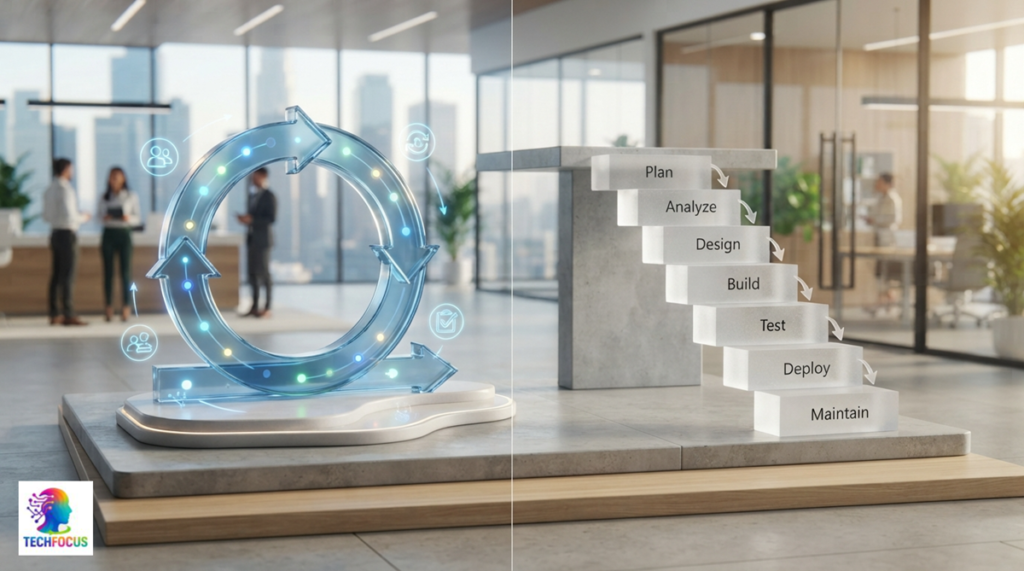
Agile vs waterfall is one of the longest-running debates in software development, and the honest answer is that neither approach is universally better; they’re built for genuinely different situations. This guide breaks down agile vs waterfall in practical terms, covering what each approach actually looks like day to day and how to decide which one fits your specific project.
What Is Waterfall, in Plain Terms?
Waterfall is a sequential approach where each phase of a project- requirements gathering, design, development, testing, deployment- happens in order, one after another, with each phase generally completed before the next one begins. It’s called “waterfall” because progress flows steadily downward through these fixed stages, much like water over a series of steps.
What Is Agile, in Plain Terms?
Agile is an iterative approach where work happens in short cycles, often called sprints, with the team building, testing, and reviewing small pieces of the product repeatedly rather than planning everything upfront in one long sequence. Requirements and priorities can shift between cycles based on feedback, rather than staying fixed from the very beginning.
What Are Waterfall’s Real Strengths?
Waterfall works well when requirements are genuinely well-understood upfront and unlikely to change significantly, such as regulated industries, contract-based projects with fixed deliverables, or projects where the cost of late-stage changes is extremely high. It also provides clear, predictable milestones and documentation, which some stakeholders and industries specifically require.
What Are Waterfall’s Real Weaknesses?
Waterfall struggles badly when requirements are uncertain or likely to evolve, since discovering a problem late in the sequential process, during testing, for instance, can require expensive rework of decisions made much earlier. It also delays actual working software until relatively late in the project, meaning stakeholders don’t see tangible results for a long stretch of time.
What Are Agile’s Real Strengths?
Agile handles changing or unclear requirements far better, since priorities can adjust between short cycles based on real feedback rather than being locked in from the start. It delivers working pieces of the product regularly, letting stakeholders see and react to actual progress much sooner, and it tends to catch problems earlier since testing happens continuously rather than only at the end.
What Are Agile’s Real Weaknesses?
Agile’s flexibility can become a liability without strong discipline; scope can creep gradually as new ideas get added between cycles, and without clear overall direction, a team can end up building a lot of individually reasonable features that don’t add up to a coherent product. It also generally requires closer, more frequent collaboration between the development team and stakeholders than waterfall does.
When Does Waterfall Genuinely Make Sense?
Waterfall tends to be the stronger choice for projects with fixed, well-understood requirements, strict regulatory or contractual documentation needs, and situations where stakeholders need firm upfront timelines and budgets rather than an evolving plan. Certain construction-adjacent or safety-critical software projects fall into this category.
When Does Agile Genuinely Make Sense?
Agile tends to be the stronger choice for products where requirements are expected to evolve based on user feedback, projects where getting something usable in front of users quickly matters, and teams that can maintain close, ongoing collaboration with stakeholders throughout development. Most modern consumer software development leans agile for exactly these reasons.
Is This Really an Agile vs Waterfall Either/Or Decision?
Not always. Many teams use a hybrid approach, applying waterfall-style upfront planning for well-understood, fixed requirements while using agile, iterative cycles for the parts of a project that are genuinely uncertain or likely to change. Treating agile vs waterfall as a strict binary choice, rather than a spectrum, can lead to forcing a poor fit onto a project that would actually benefit from mixing elements of both.
Does Company Culture Play a Role in Agile vs Waterfall Success?
Yes, more than many teams expect. Agile requires a culture comfortable with ongoing change and frequent check-ins, while waterfall fits organisations that value detailed upfront planning and formal sign-offs between phases. Forcing either approach onto a culture that doesn’t match its working style tends to create friction regardless of which method is technically better suited to the project itself.
Does Team Size Affect Which Approach Works Better?
Somewhat. Agile’s frequent collaboration and short cycles tend to work more naturally with smaller, tightly coordinated teams. Waterfall’s more structured, documented phases can sometimes coordinate large, complex projects with many separate teams or contractors more predictably, since responsibilities and handoffs between phases are defined clearly upfront.
How Do You Actually Decide Between Them?
Ask honestly: how well-understood and stable are the requirements? How important is delivering working software quickly versus following a predictable, documented timeline? How closely can your team collaborate with stakeholders throughout the project? Answering these questions honestly, rather than defaulting to whichever approach is more fashionable, leads to a better-fitting decision for your specific project.
Final Answer: There’s No Universal Winner
Agile vs waterfall isn’t a competition with one correct answer; it’s a tradeoff between structure and flexibility that depends entirely on how well-understood your requirements are and how your team and stakeholders actually work together. Matching the approach to your specific project’s real characteristics, rather than picking a side based on general reputation, leads to noticeably better outcomes.
Frequently Asked Questions
Is agile always better than waterfall for software projects?
Not always. Waterfall can genuinely work better for projects with fixed, well-understood requirements and strict documentation needs.
Can a team use both agile and waterfall on the same project?
Yes, many teams use a hybrid approach, applying upfront planning for stable requirements and iterative cycles for uncertain parts of a project.
Does agile require more collaboration with stakeholders than waterfall?
Generally yes, since agile relies on regular feedback between short cycles, while waterfall’s structure allows for less frequent stakeholder involvement.
Is waterfall outdated compared to agile?
No, it’s still genuinely useful for certain regulated, contract-based, or fixed-requirement projects where predictability matters more than flexibility.
What’s the biggest risk of using agile without discipline?
Scope creep is a common risk, where gradually adding new ideas between cycles leads to a product that lacks coherent overall direction.